The 2026 Sea Freight and Air Freight Update: Navigating the Waves for Aussie Businesses
If you’re running a business in Australia that relies on importing heavy machinery, building materials, or bulk retail inventory, you already know the golden rule of logistics: sea freight is typically your most economical option. When you’re moving large or heavy shipments and time isn’t your biggest enemy, putting it on a boat heading for Sydney, Melbourne, or Brisbane just makes sense. Sure, the transit times are longer, often taking several weeks depending on whether your goods are coming from Asia, Europe, or the States, but the cost per cubic metre is significantly lower than copping the massive fees of air freight.
But as we sail deep into 2026, the global shipping game has changed. The old rules still apply, but the modern world is throwing a few curveballs our way. Here is a look at what the current global landscape means for Aussie importers and exporters.
“Economical” Now Requires a Bit of Strategic Knowledge
While ocean freight is still the undisputed champion for cost-effective bulk shipping, securing those low costs isn’t as simple as it used to be.
The Phantom Ships: Globally, we’re actually seeing an oversupply of shipping vessels in 2026. Normally, this would mean dirt-cheap prices for you. The major shipping lines have gotten incredibly smart about managing this by using “blank sailings”, essentially cancelling scheduled voyages to restrict capacity and keep prices from dropping.
Spot Rates vs. Contracts: Because carriers are pulling ships in and out of rotation, relying on last-minute spot rates is a massive gamble. For Aussie businesses, cost predictability is now much more important than just hunting for the lowest base price on a single shipment.
The “Tyranny of Distance” Has Gotten Less Predictable
As Aussies are used to things taking a while to get here, the phrase “several weeks depending on origin” is far less guaranteed today than it was a few years ago.
Geopolitical Detours: Ongoing global conflicts and the ripple effects of the Red Sea disruptions mean many vessels coming from Europe are still taking the long way ’round the Cape of Good Hope. If you’re bringing goods in from the EU, a few weeks can quickly turn into a month or more.
Wild Weather: Climate disruptions aren’t just rare acts of God anymore; they’re standard operational hiccups. Sudden storms in the Asia-Pacific or port congestion up north mean the first available ship might end up stuck in a queue before it even points its bow toward Australia.
Rethinking How We Ship “Bulk”
Because transit times are bouncing around, the way clever supply chain managers move their bulk goods is evolving.
If you try to load a massive, singular block of cargo onto a ship in Shenzhen, there is a higher risk of it getting “rolled” (bumped off a fully loaded vessel to wait for the next one). To combat this, many Aussie businesses are breaking massive shipments down into smaller, more agile lots (under 2 to 4 TEUs). It takes a bit more coordination, but it dramatically increases the chances of your inventory actually getting on the boat.
The True Landed Cost in Aussie Dollars
Finally, we have to look at the big macroeconomic picture. Sea freight itself is cheap, but the world is heavily focused on shifting trade policies, nearshoring, and tariff reviews right now.
When you’re calculating your logistics budget, you can’t just look at the freight invoice. The total landed cost—factoring in sudden tariff changes, new compliance paperwork, currency fluctuations with the Aussie dollar, and global trade tensions—means the cheapest sea route on paper might end up biting into your margins once it finally clears Australian customs.
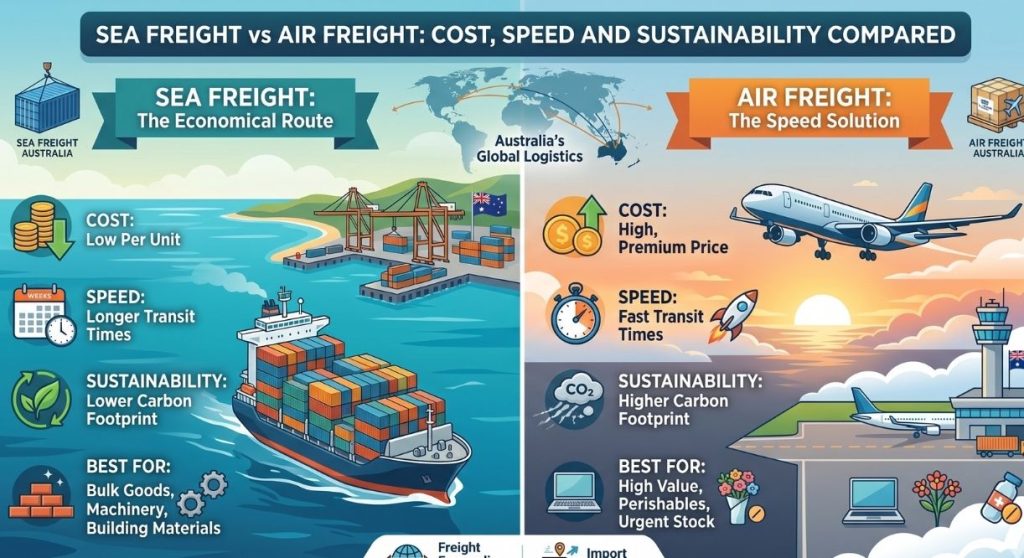
Sea Freight vs Air Freight: Cost, Speed and Sustainability Compared
Choosing between sea freight Australia options and air freight Australia routes is a commercial decision that affects cost, transit time and supply chain reliability. For Australian businesses operating in global markets, selecting the right transport mode is essential when conducting an import logistics comparison.
Sea freight is typically the most economical option for large or heavy shipments. It is well suited to bulk goods, machinery, building materials and non-urgent inventory. Transit times are longer, often several weeks depending on origin, but the cost per cubic metre is significantly lower than air freight.
Air freight is designed for speed. High-value goods, perishable products, urgent spare parts and seasonal retail stock often travel by air. Transit times are usually measured in days rather than weeks. However, the cost per kilogram is substantially higher.
Beyond price and speed, there are other factors to consider when shipping to Australia.
Reliability is influenced by port congestion, airline capacity and global demand cycles. Sea freight can be impacted by shipping schedule changes or port delays. Air freight can be affected by reduced cargo space during peak passenger travel seasons.
Sustainability is becoming increasingly important for Australian businesses. Sea freight generally produces lower emissions per tonne of cargo compared to air freight. Companies with environmental reporting obligations may factor this into their logistics planning.
Customs clearance requirements apply regardless of transport mode. Documentation accuracy remains critical, and certain goods may attract inspections irrespective of how they arrive.
In many cases, businesses adopt a blended approach. Core inventory travels by sea, while urgent replenishment shipments are sent by air. This strategy balances cost efficiency with responsiveness.
There is no single correct answer. The right choice depends on your product type, customer expectations, budget and supply chain risk tolerance. Consulting with an experienced professional to explore your freight forwarding options ensures your transport decisions align with your commercial objectives.
Express Customs and Forwarders are always looking at ways to save you time, money and effort. Let us take the reins and we can help you control costs along with getting the right moving strategy together.
The Bottom Line for 2026
If you’re moving non-urgent, heavy freight, the ocean is still your best mate. But in 2026, you can’t just set and forget your sea freight strategy. Success today means keeping a close eye on global chokepoints, building flexibility into your supply chain, and focusing on schedule reliability just as much as the sticker price.